
AI SEO for startups is a different job than it was two years ago. People still type queries into Google, but a growing share of them now get a written answer from an AI Overview, a chatbot, or an assistant built into their browser before they ever see a list of links. If your startup’s growth plan rests on ranking a few blog posts and waiting for clicks, that plan needs revisiting.
The good news is that most of what works now is not exotic. It rewards clear writing, narrow focus and real expertise, which small teams can do well. The bad news is that the lazy shortcuts have stopped paying off. This post covers what has changed, where startups have an edge, and how to build a strategy you can run with two or three people.
What actually changed in search ?
For a long time, SEO was a fairly simple loop. You found a keyword, wrote a page, earned some links, and watched your position climb. Traffic followed position. That loop is weaker now because the search result page does more of the work itself. A user asking “how do I set up usage-based billing” may get a summary at the top, with a few sources cited underneath. Some of those users never click. Others click only when the summary leaves a gap, such as a comparison, a template, a tool, or an opinion from someone who has done the thing.
Two consequences follow. First, informational queries with simple answers are the most exposed. If a question can be answered in three sentences, an AI system will answer it in three sentences, and your page becomes a source at best. Second, being cited or mentioned inside those answers is now a goal alongside ranking. Some people call this generative engine optimization or answer engine optimization. The label matters less than the idea: you want to be the source that AI systems pull from, and the brand that people remember afterward.
None of this means traditional SEO is dead. Google still sends a great deal of traffic, and the same signals that help you rank (useful content, clean technical setup, trust) also help you get cited. What has changed is the mix of effort, and what counts as a page worth publishing. AI SEO for startups means combining traditional search fundamentals with visibility in AI-generated answers.

Why startups are in a better spot than they think ?
Big companies have domain authority and budgets. Startups have three things that matter more than they used to.
- The first is speed. You can publish a response to a product change, an industry shift, or a customer question the same week it happens. Larger companies often need weeks of approvals.
- The second is proximity to real customers. You talk to buyers every day. You know which objections come up, which words they use, and which problems keep them awake. That is exactly the raw material AI-generated content lacks, and it is why generic articles are becoming easy to ignore.
- The third is focus. A startup serves a specific group of people with a specific problem. In a world where AI systems summarize the generic middle of the internet, a narrow and credible voice stands out.
The weakness is obvious too: low authority, few backlinks, a small team. So the strategy has to be selective. You can’t cover everything, so you choose where to be the best answer. A focused strategy is what makes AI SEO for startups realistic for teams with limited time and budget.
Choose a narrow territory and own it.
The most common startup SEO mistake is trying to rank for broad terms. “Project management software” or “email marketing” will be dominated by established players for years. Spending a year of content on those terms is a slow way to get nowhere.
Instead, define a territory: a cluster of related topics where your product and your team’s experience give you a real claim to expertise. If you sell invoicing software for freelance designers, your territory is not “invoicing.” It is something like “getting paid as a freelance designer,” covering late payments, contracts, deposits, pricing projects, and handling difficult clients.
Within that territory, aim for depth. Cover the subtopics thoroughly and link them together so that a reader (or a crawler) can see you have covered the subject from several angles. A tight cluster of ten strong pages usually does more than fifty scattered ones, because search systems and AI models both seem to favor sources that show consistent expertise on a subject.
A simple test for any topic: could someone on your team add something to this page that a competitor couldn’t? If the answer is no, skip it or save it for later. This topic-cluster approach gives AI SEO for startups a clear direction instead of spreading effort across unrelated keywords.

Write pages that answer the question and then go further.
AI systems tend to pull from pages that state things plainly. That doesn’t mean writing thin content. It means putting the direct answer where it’s easy to find, then giving the reader a reason to stay. A practical structure looks like this. Open with the answer in a sentence or two. Follow with the reasoning, the exceptions, and the details. Add an example, a template, or a worked scenario. Close with what to do next.
Some habits help both readers and machines:
- Use headings that sound like the questions people ask, so the structure is obvious.
- Define terms the first time you use them, in plain language.
- Keep paragraphs focused on one idea.
- Use a table when you’re comparing options across several attributes, and a numbered list when the order of steps matters. Don’t force either one onto content that reads fine as prose.
- Add a short FAQ only when the questions are real ones you’ve heard from customers.
The second half of that structure is the important part. If your page only restates what a summary already says, there’s no reason for anyone to click. The pages that still earn visits offer something a summary can’t: a calculator, a checklist, a screenshot walkthrough, a candid comparison, or a strong point of view. That extra value is central to AI SEO for startups because it gives both readers and AI systems a reason to notice your page.
Publish things only you can publish
This is the biggest shift in how I’d advise a startup to spend its time. Original material is becoming the main differentiator, because everything else can be generated by anyone. Original material can take many forms. You might share data from your own product (anonymized and aggregated, with permission handled properly). You might run a small survey of your customers and publish the results. You might document how you solved a hard problem, including what failed. You might interview a customer or an expert and publish the conversation. You might write up a teardown of how a competitor handles a specific feature.
Each of these gives other writers something to cite, gives AI systems something distinctive to draw on, and gives readers a reason to remember your name. A single well-built original study can earn more attention than a year of generic blog posts.
It also helps to put real names on your content. Author bios with actual credentials, a clear “about” page, and visible experience all support what search engines call E-E-A-T: experience, expertise, authoritativeness and trust. Anonymous, voiceless content is the easiest kind to replace.

Build your reputation outside your own website.
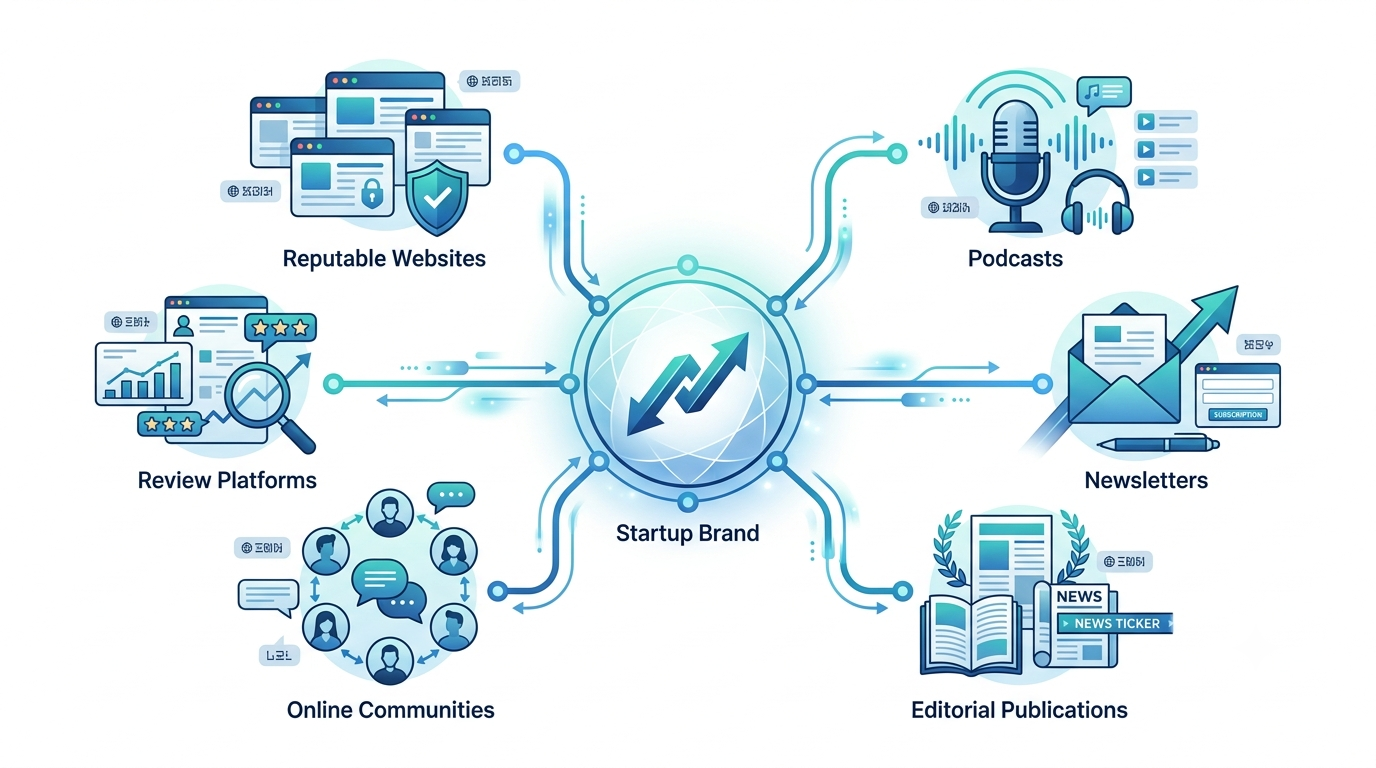
AI systems don’t only read your site. They form a picture of your brand from everywhere it appears: review sites, forums, social posts, podcasts, newsletters, directories, and other people’s articles. If that picture is thin or inconsistent, you are less likely to be mentioned when someone asks an assistant for a recommendation in your category. For a startup, this means treating off-site presence as part of SEO rather than as separate PR work. A few places to focus:
Review platforms in your category. If buyers in your market check a particular directory, make sure your listing is complete and that happy customers are leaving honest reviews. Communities where your audience already talks. Answer questions in forums, subreddits and Slack groups with real help, not link drops. Over time, people recognize the name. Guest appearances. Podcasts, webinars and newsletters in your niche give you a mention, often a link, and a chance to explain your thinking in your own words.
Consistency. Describe your company the same way everywhere: what it does, who it’s for, what makes it different. Inconsistent descriptions make it harder for any system to categorize you.
Digital PR in the old sense still works as well. A link from a respected publication in your field carries weight for traditional rankings and adds to your credibility everywhere else. For AI SEO for startups, credible mentions beyond your own website can strengthen brand recognition and trust.
Don’t neglect the technical basics.
Fancy strategy falls apart on a shaky foundation. Before investing heavily in content, check that the basics are sound. Your site should load quickly on mobile, be easy to crawl, and have a clean structure with sensible URLs. Make sure important pages are indexable and that you haven’t accidentally blocked them. Use structured data (schema markup) where it fits, such as articles, products, FAQs, organizations and reviews, because it helps machines understand what each page is.
Also decide, deliberately, how you want AI crawlers to treat your content. Some site owners allow them, some block them, and the right call depends on your business. If your goal is visibility in AI answers, blocking the crawlers works against you. If your content is the product, you may want tighter control. Either way, make it a decision rather than a default. Check your robots.txt and your hosting or CDN settings, since some platforms block certain bots automatically.
Keep your key pages current as well. Out-of-date pricing, old screenshots and stale statistics hurt trust with readers and give AI systems wrong information about you. A short quarterly review of your most important pages is worth the time. Keeping these pages accurate is an important part of AI SEO for startups, especially when AI tools may surface outdated information.

Use AI tools, but don’t let them write your strategy.
Most startups will use AI in their content workflow, and that’s reasonable. The tools are good at research summaries, outlines, first drafts, keyword clustering, meta descriptions, and cleaning up awkward sentences. For a small team, that saves real hours.
The risk is publishing what comes out without adding anything. Unedited AI drafts tend to sound alike, repeat common knowledge and make confident claims that turn out to be wrong. Readers notice, and search systems are increasingly good at telling when a page offers nothing new.
A workable approach is to let AI handle the scaffolding and keep humans on the parts that matter. Someone with real experience should supply the examples, the opinions and the specifics. Someone should check every fact, number and quote before it goes live. And someone should read the final piece out loud and cut anything that sounds like it could have appeared on any other site.
If a draft could be published unchanged by your competitor, it isn’t ready.
Measure what matters now?
Traditional metrics still count, but they don’t tell the full story anymore. Rankings and organic clicks are worth tracking, though impressions may rise while clicks stay flat as AI summaries absorb some queries. Don’t panic at that pattern; look at what happens after the click instead.
Useful signals for a startup include:
- Sign-ups, demo requests or trials that come from organic search, rather than raw traffic
- Branded search volume, since people searching your company name is a sign your reputation is spreading
- Mentions and citations in AI answers, which you can check manually by asking the major assistants the questions your customers ask and noting whether you appear
- Referral traffic from AI platforms, which most analytics tools can now separate
- Backlinks and mentions from respected sites in your field
A simple tracking routine helps you judge whether AI SEO for startups is bringing qualified visitors and meaningful mentions. Set up a simple monthly routine. Pick fifteen to twenty questions your ideal customers would ask, run them through search and a couple of AI assistants, and record who gets mentioned. It isn’t perfect science, because answers vary, but trends over several months are informative. Treat it as a rough compass.
A realistic 90-day plan
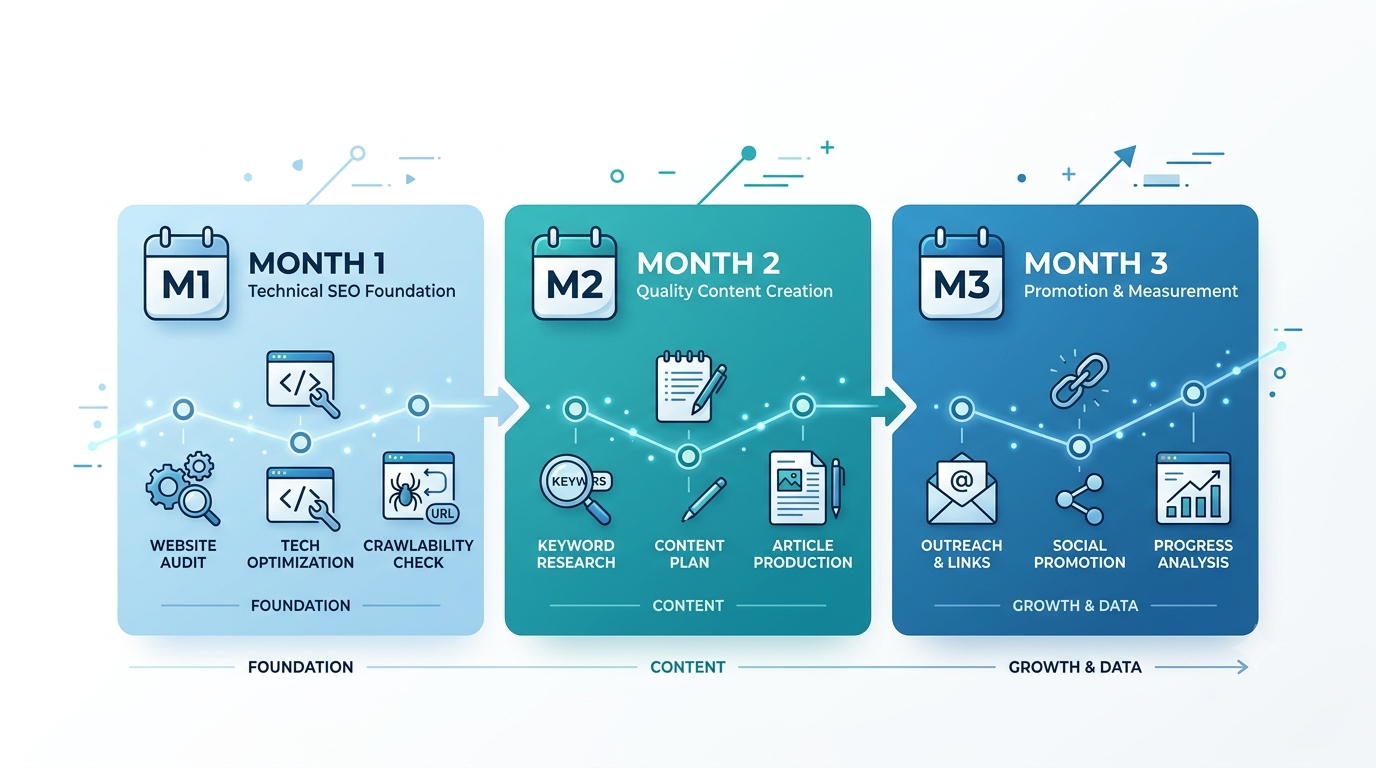
If you’re starting from a modest base, here’s how I’d sequence the work.
In the first month, fix the foundation. Audit your technical setup, decide your stance on AI crawlers, update your most important pages, and write down your territory: the five or six topics where you can credibly claim expertise. Interview a few customers to collect the questions and phrases they actually use.
In the second month, build your core content. Publish the strongest pages in your territory, each with an upfront answer, a clear structure and something original. Aim for quality over volume. Three excellent pages beat ten mediocre ones. Add real author bios and tidy up your about page.
In the third month, start extending your reach. Pitch one original piece of research or a strong opinion to a few publications or newsletters in your niche. Be useful in two or three communities. Collect reviews. Run your first round of question tracking so you have a baseline to compare against.
After that, repeat the cycle: refresh, publish, promote, measure. The compounding effect comes from consistency, not bursts. This steady cycle turns AI SEO for startups into a repeatable process rather than a one-time content campaign.
Common mistakes in AI SEO for startups
The most frequent mistake is chasing volume. A founder reads that content matters, hires a freelancer or sets up an AI workflow, and ends up with sixty thin posts that say what everyone else already says. Those pages rarely rank and almost never get cited. A second mistake is treating AI visibility as a separate project from regular SEO, when the same fundamentals drive both: clear answers, real expertise, a crawlable site and a trustworthy reputation. Others skip measurement entirely, so they can’t tell what’s working. And plenty of teams copy a competitor’s keyword list without asking whether they have anything different to say about those topics. If you avoid these four, you’re already ahead of most startups.
This section would fit well just before “A realistic 90-day plan.”
What to remember?
SEO in 2026 is less about gaming a ranking formula and more about becoming a source people and machines both trust. For a startup, that points in a clear direction. Pick a narrow area and know it better than anyone. Write pages that answer questions directly and then offer more than a summary can. Publish original material that only you could produce. Build a reputation beyond your own site. Keep the technical side tidy. Use AI to speed up the work, not to replace your thinking.
The startups that do this won’t win every query, and traffic patterns will keep shifting as the tools change. But they’ll have something more durable than a spot on a results page: a recognizable name in the places where their customers go looking for answers.
Explore digitallybypriti to learn more about our services, solutions, and expertise in AI SEO for startups.
Pingback: How to Use AI in Marketing: 7 Proven Steps for 2026 -