
Author name: pritidhillon943@gmail.com

AI in digital marketing with analytics dashboards and intelligent marketing tools
Digital Marketing

How to Use AI in Marketing: 7 Proven Steps for 2026

Businesses, freelancers, creators and digital marketers are all asking how to use AI in marketing. AI is changing how brands create content, understand customers, analyze data, run campaigns and talk to their audiences. It can save time on repetitive tasks and help you get more out of your resources. It doesn’t replace human creativity and strategy, though. The best results come from pairing AI with human judgment and a clear understanding of your target audience. This guide covers what AI marketing is, where it’s most useful, some practical examples, the main tool categories, and how to use AI responsibly. What is AI marketing? AI marketing means using artificial intelligence to support marketing work. Traditionally, marketers research audiences, write content, analyze campaigns and spot trends by hand. AI can help with many of these tasks because it processes large amounts of information quickly and turns it into usable insights. It can be applied to: Content creation Customer research Search engine optimization Social media marketing Advertising Data analysis Personalization Customer support Marketing automation The point isn’t to automate everything. It’s to spend less time on repetitive work and more on strategy and creative decisions. Using AI for content creation Content creation is the easiest place to start. Digital marketing needs a steady supply of blog posts, social captions, ads, email campaigns, product descriptions, video ideas and website copy, and AI can produce ideas and first drafts for all of them. A marketer working for a skincare brand, for instance, could use AI to brainstorm: Blog topics Instagram post ideas Video concepts Product descriptions Email subject lines Frequently asked questions Content calendar ideas Don’t publish AI-generated content without reviewing it. A better process is: Research → AI brainstorming → Human editing → Fact-checking → Optimization → Publishing. That way you get the benefit of AI and still keep the content original and accurate. Using AI for SEO and keyword research SEO means understanding what people search for, writing useful content, optimizing pages and analyzing competitors. AI can help you brainstorm keywords, find related topics, organize content clusters and draft article structures. If your main topic is digital marketing, for example, it can suggest related topics such as: Digital marketing strategies AI marketing tools Social media marketing Content marketing Email marketing SEO for beginners Marketing automation AI can also help build SEO briefs by suggesting headings, questions readers may ask and related concepts to cover. Don’t rely on AI alone for keyword research. Check search demand, competition, relevance and user intent in a reliable SEO platform. If you’re running a startup and want to improve your search rankings, having the right SEO strategy is essential. Check out our guide on [AI SEO for Startups: 7 Amazing Tips to Improve Your SEO Strategy] to discover practical ways to use AI to strengthen your startup’s SEO efforts. Using AI for social media Social media rewards consistency. Businesses have to post regularly and keep the content relevant, and AI can help by generating ideas and variations. One blog post can become several pieces of content: Blog post → Instagram carousel → LinkedIn post → Short video script → Email newsletter. AI can adapt the same core idea to each platform. It can also help with: Caption ideas Hooks Content calendars Hashtag brainstorming Short-form video scripts Audience questions Post variations Keep your brand voice consistent. AI-written captions can sound generic, so edit them by hand if you want the content to feel authentic and connected to your audience. Using AI for email marketing Email is another place where AI saves a lot of time. It can help you brainstorm subject lines, organize campaigns, personalize messages and write different versions of an email for different segments. An online store could write separate emails for: New customers Returning customers Customers who abandoned their carts Customers interested in a particular product Newsletter subscribers Rather than sending everyone the same message, businesses can use customer information to make emails more relevant. AI can also look through past campaigns for patterns, such as which subject lines got more engagement or which content drew more clicks. Using AI for customer research Successful marketing starts with understanding customers. AI can organize and analyze feedback from surveys, reviews, comments and other sources. Say a company gets hundreds of customer reviews. Reading all of them takes a long time, but AI can sort them into common themes such as: Product quality Price concerns Delivery experience Customer service Product features Common complaints Marketers can use these themes to see what customers value and which problems need attention. AI doesn’t understand customers perfectly, so a person still has to interpret the findings in the context of the business. AI-powered personalization Customers increasingly expect relevant experiences. AI can personalize marketing messages based on customer behavior and preferences. An e-commerce site, for example, may recommend products based on what a customer has browsed or bought before. Personalization also applies to: Email recommendations Website experiences Product suggestions Advertising Content recommendations Customer communication Used responsibly, personalization makes marketing more relevant. Pay attention to privacy, transparency and any data-protection rules that apply when you use customer information. Using AI for advertising Paid advertising needs constant testing. Marketers often have to create multiple headlines, descriptions, visual concepts and audience variations before they find the combinations that perform. AI can produce those variations. Instead of writing a single headline, you could generate several and test them. AI can also analyze campaign data and look for patterns in: Click-through rates Conversions Engagement Cost per acquisition Audience segments Ad performance Base final decisions on verified campaign data, not on AI assumptions. AI for marketing analytics Marketing produces a lot of data: website visits, social engagement, email clicks, conversions, customer behavior and ad performance. AI can help marketers find patterns in it. AI-assisted analysis might show, for example, that: A particular blog topic attracts more visitors. A certain audience interacts more with video content. One email subject line performs better than another. A particular landing page gets traffic […]

AI SEO for startups
AI, Digital Marketing, Marketing, SEO

AI SEO for Startups: 7 Amazing Tips to Improve Your SEO Strategy

AI SEO for startups is a different job than it was two years ago. People still type queries into Google, but a growing share of them now get a written answer from an AI Overview, a chatbot, or an assistant built into their browser before they ever see a list of links. If your startup’s growth plan rests on ranking a few blog posts and waiting for clicks, that plan needs revisiting. The good news is that most of what works now is not exotic. It rewards clear writing, narrow focus and real expertise, which small teams can do well. The bad news is that the lazy shortcuts have stopped paying off. This post covers what has changed, where startups have an edge, and how to build a strategy you can run with two or three people. What actually changed in search ? For a long time, SEO was a fairly simple loop. You found a keyword, wrote a page, earned some links, and watched your position climb. Traffic followed position. That loop is weaker now because the search result page does more of the work itself. A user asking “how do I set up usage-based billing” may get a summary at the top, with a few sources cited underneath. Some of those users never click. Others click only when the summary leaves a gap, such as a comparison, a template, a tool, or an opinion from someone who has done the thing. Two consequences follow. First, informational queries with simple answers are the most exposed. If a question can be answered in three sentences, an AI system will answer it in three sentences, and your page becomes a source at best. Second, being cited or mentioned inside those answers is now a goal alongside ranking. Some people call this generative engine optimization or answer engine optimization. The label matters less than the idea: you want to be the source that AI systems pull from, and the brand that people remember afterward. None of this means traditional SEO is dead. Google still sends a great deal of traffic, and the same signals that help you rank (useful content, clean technical setup, trust) also help you get cited. What has changed is the mix of effort, and what counts as a page worth publishing. AI SEO for startups means combining traditional search fundamentals with visibility in AI-generated answers. Why startups are in a better spot than they think ? Big companies have domain authority and budgets. Startups have three things that matter more than they used to. The first is speed. You can publish a response to a product change, an industry shift, or a customer question the same week it happens. Larger companies often need weeks of approvals. The second is proximity to real customers. You talk to buyers every day. You know which objections come up, which words they use, and which problems keep them awake. That is exactly the raw material AI-generated content lacks, and it is why generic articles are becoming easy to ignore. The third is focus. A startup serves a specific group of people with a specific problem. In a world where AI systems summarize the generic middle of the internet, a narrow and credible voice stands out. The weakness is obvious too: low authority, few backlinks, a small team. So the strategy has to be selective. You can’t cover everything, so you choose where to be the best answer. A focused strategy is what makes AI SEO for startups realistic for teams with limited time and budget. Choose a narrow territory and own it. The most common startup SEO mistake is trying to rank for broad terms. “Project management software” or “email marketing” will be dominated by established players for years. Spending a year of content on those terms is a slow way to get nowhere. Instead, define a territory: a cluster of related topics where your product and your team’s experience give you a real claim to expertise. If you sell invoicing software for freelance designers, your territory is not “invoicing.” It is something like “getting paid as a freelance designer,” covering late payments, contracts, deposits, pricing projects, and handling difficult clients. Within that territory, aim for depth. Cover the subtopics thoroughly and link them together so that a reader (or a crawler) can see you have covered the subject from several angles. A tight cluster of ten strong pages usually does more than fifty scattered ones, because search systems and AI models both seem to favor sources that show consistent expertise on a subject. A simple test for any topic: could someone on your team add something to this page that a competitor couldn’t? If the answer is no, skip it or save it for later. This topic-cluster approach gives AI SEO for startups a clear direction instead of spreading effort across unrelated keywords. Write pages that answer the question and then go further. AI systems tend to pull from pages that state things plainly. That doesn’t mean writing thin content. It means putting the direct answer where it’s easy to find, then giving the reader a reason to stay. A practical structure looks like this. Open with the answer in a sentence or two. Follow with the reasoning, the exceptions, and the details. Add an example, a template, or a worked scenario. Close with what to do next. Some habits help both readers and machines: Use headings that sound like the questions people ask, so the structure is obvious. Define terms the first time you use them, in plain language. Keep paragraphs focused on one idea. Use a table when you’re comparing options across several attributes, and a numbered list when the order of steps matters. Don’t force either one onto content that reads fine as prose. Add a short FAQ only when the questions are real ones you’ve heard from customers. The second half of that structure is the important part. If your page only restates what a summary […]

Digital Marketing

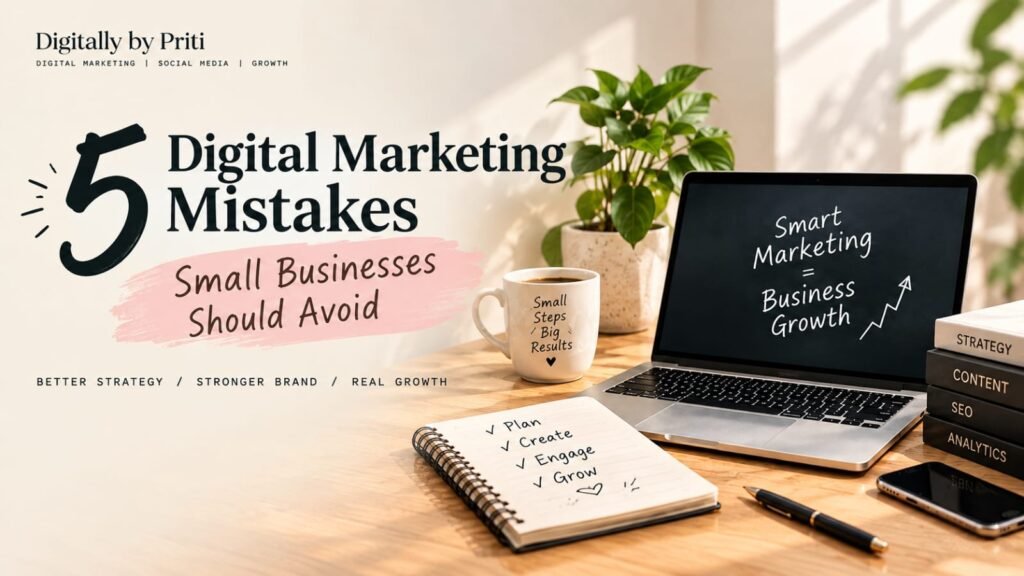
5 Digital Marketing Mistakes Small Businesses Should Avoid

 Digital Marketing Mistakes: In today’s digital-first world, having an online presence is essential for almost every business. Customers search for brands on Google, discover products through social media, read online reviews, and often make purchasing decisions based on what they see online. However, simply having a website or social media account does not guarantee success. Many small businesses invest time and money in digital marketing but struggle to get results because of a few common mistakes. The good news is that most of these mistakes are easy to identify and avoid. Here are to build a stronger online presence and achieve better results. 1. Trying to Be Everywhere One of the most common Digital Marketing mistakes businesses make is trying to maintain a presence on every social media platform. A business may create accounts on Instagram, Facebook, LinkedIn, YouTube, Pinterest, and other platforms without first understanding where its target audience spends time. Managing all these platforms can become difficult, especially for a small team. Instead of trying to be everywhere, focus on the platforms that are most relevant to your audience. For example, a fashion brand may benefit greatly from visual platforms such as Instagram, while a B2B company may find LinkedIn more valuable. The goal is not to have the largest number of social media accounts but to build a meaningful presence where your potential customers are actually active. Focus on the right audience, not every audience. 2. Posting Without a Strategy Another common Digital Marketing mistake is posting content randomly without having a clear goal. Posting occasionally whenever an idea comes to mind may keep your account active, but it does not necessarily help build a brand. Successful digital marketing requires a strategy that connects content with specific business objectives. Before creating content, ask yourself: Who is my target audience? What problems do they have? What information can I provide? What action do I want them to take? What does my brand want to achieve? A simple content strategy can include educational posts, customer-focused content, product or service information, behind-the-scenes content, and promotional posts. Consistency is also important. You do not necessarily need to post every day. A realistic and consistent schedule is much better than posting frequently for a few weeks and then disappearing. 3. Ignoring Search Engine Optimization (SEO) Having a website is great, but a website that nobody can find is unlikely to generate much traffic. This is where Search Engine Optimization (SEO) becomes important. SEO helps businesses improve their visibility in search engine results when people search for relevant products, services, or information. Small businesses sometimes ignore SEO because they believe it is complicated or only useful for large companies. In reality, local and small businesses can benefit significantly from a well-planned SEO strategy. Basic SEO practices include using relevant keywords, creating useful content, optimizing page titles and descriptions, improving website speed, making the website mobile-friendly, and creating content that answers customers’ questions. For a local business, maintaining accurate business information and developing a strong local online presence can also help potential customers discover the business. SEO is not usually an overnight strategy. It requires consistency, useful content, and patience, but it can create valuable long-term visibility. 4. Focusing Only on Selling Imagine following a brand on social media and seeing nothing except “Buy Now,” “Limited Offer,” and “Shop Today.” Constant promotion can make an audience lose interest. Digital marketing should not only be about selling products or services. It should also be about building relationships and providing value. Businesses can share tips, tutorials, educational content, customer stories, industry insights, frequently asked questions, and useful information related to their products or services. For example, instead of a skincare brand only promoting a serum, it could create content about skincare routines, common skincare mistakes, ingredient education, and general skincare tips. When businesses consistently provide useful content, they can build credibility and trust. Once customers trust a brand, they are more likely to consider its products or services.                                               “Educate first. Connect second. Sell with purpose.” 5. Not Tracking Marketing Results One of the biggest digital marketing mistakes is spending time and money on campaigns without checking whether they are actually working. Likes and followers can be useful indicators, but they do not always represent business success. A campaign may receive thousands of views but generate very few website visits, enquiries, or sales. Businesses should identify the metrics that matter for their goals. For example: Website traffic Engagement rate Link clicks Leads or enquiries Conversion rate Email sign-ups Customer acquisition cost Return on advertising spend Tracking these results helps businesses understand what is working and what needs improvement. Digital marketing gives businesses the advantage of measurable data. Instead of simply guessing, marketers can use this information to make smarter decisions and improve future campaigns. How Small Businesses Can Improve Their Digital Marketing Avoiding theseDigital marketing mistakes is a good starting point, but successful digital marketing requires continuous learning and improvement. Start by clearly defining your target audience and business goals. Choose the platforms that make sense for your audience, create a realistic content strategy, optimize your online presence for search, and focus on providing genuine value. Most importantly, review your results regularly. If something is not working, do not be afraid to change your approach. Digital marketing is not about doing everything at once. It is about doing the right things consistently and improving them over time. Conclusion Digital marketing can provide small businesses with powerful opportunities to reach customers, build brand awareness, and grow online. But success does not come simply from posting more content or spending more money on advertisements. By avoiding common mistakes such as trying to be everywhere, posting without a strategy, ignoring SEO, focusing only on sales, and failing to track results, small businesses can create a more focused and effective digital marketing strategy. Remember: “a strong digital […]

Digital Marketing, Marketing

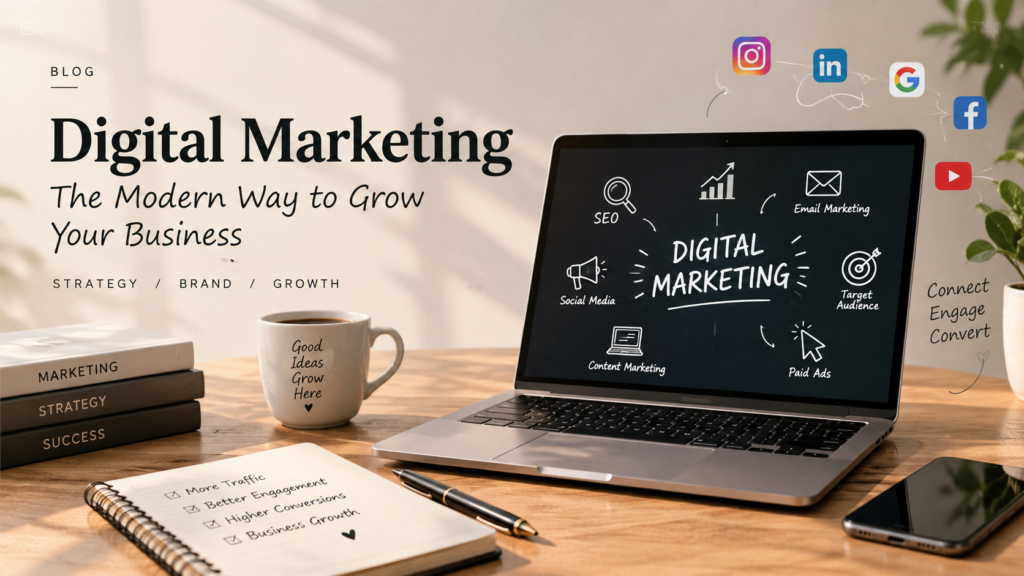
Digital Marketing: 5 Powerful Insights for Beginners

In today’s digital world, a great product or service is not enough. Digital marketing helps businesses reach the right people at the right time and in the right place. Digital marketing, from social media and search engines to email and websites, has changed the way businesses connect with customers. Digital marketing is useful whether you are a small business owner, freelancer, startup, or established company. Understanding digital marketing can help you build your brand, attract customers, and grow your business online. What Is Digital Marketing? Digital marketing is the promotion of products, services, or brands through digital channels such as search engines, social media platforms, websites, email, and online advertisements. Digital marketing differs from traditional marketing, which often relies on newspapers, television, radio, or billboards, because it lets businesses talk directly to their target audience online. Digital marketing is at work when you search for a product on Google and see an ad, follow a brand on Instagram, or get a promotional email from a company. Why Is Digital Marketing Important? Digital marketing matters because the internet is now part of everyday life. People use search engines to find information, social media to discover brands, and websites to compare products before they buy. Digital marketing helps businesses take advantage of these habits. Digital marketing’s biggest advantage is reach. With digital marketing, a small business can promote its products to people in its local area and also to customers in other cities, states, or even countries. Digital marketing is also measurable. Businesses can track website visits, social media engagement, ad clicks, leads, and conversions, so digital marketing shows marketers what is working and where to improve their strategies. Major Types of Digital Marketing Digital marketing includes several different techniques. Some of the most important ones are: 1. Search Engine Optimization (SEO) Digital marketing through SEO helps websites appear higher in search engine results. When people search for something related to your business, a well-optimized website has a better chance of being found. Digital marketing work in SEO includes keyword research, creating useful content, improving website performance, and building quality links. 2. Social Media Marketing Digital marketing on platforms such as Instagram, Facebook, LinkedIn, and YouTube gives businesses strong ways to connect with their audiences. Digital marketing on social media involves creating content, engaging with followers, building communities, and promoting products or services through organic posts and paid ads. Digital marketing on social media can also help freelancers and personal brands show their skills and attract potential clients. 3. Content Marketing Digital marketing through content focuses on creating valuable and relevant content for an audience. This can include blogs, videos, infographics, social media posts, guides, and podcasts. Digital marketing with content does not simply tell people to buy something. It offers useful information that builds trust and establishes a brand as knowledgeable in its field. 4. Email Marketing Digital marketing through email is a direct way for businesses to communicate with their customers. It can be used to share newsletters, product updates, special offers, useful content, and personalized recommendations. Digital marketing by email works best when it sends relevant content to the right audience instead of too many promotional messages. That approach helps businesses build trust, maintain customer relationships, and encourage repeat engagement. 5. Paid Advertising Digital marketing through paid advertising lets businesses reach specific audiences on platforms such as search engines and social media. Digital marketing with paid ads has one major benefit: targeting. Advertisers can often choose audiences by interests, location, demographics, or online behavior. Digital marketing campaigns can then be measured and adjusted based on the results. Benefits of Digital Marketing Digital marketing offers several benefits for businesses of different sizes. Digital marketing is cost-effective. Many digital marketing methods can be started with relatively small budgets, which makes them useful for startups and small businesses. Digital marketing offers targeted reach. Businesses can focus their marketing efforts on specific audiences instead of speaking to everyone. Digital marketing leads to better engagement. Social media and other digital platforms let businesses interact directly with customers. Digital marketing gives measurable results. Digital campaigns can be tracked with various analytics tools, so businesses can see how they are performing. Digital marketing supports brand building. Consistent online content can help a business develop recognition, credibility, and trust. Digital Marketing for Freelancers Digital marketing is not only useful for companies. Digital marketing can also be valuable for freelancers. Digital marketing lets a freelancer use a professional website, social media profiles, content, and online networking to show their skills and attract clients. A digital marketer, for example, can share case studies, marketing tips, portfolio projects, and educational content to demonstrate expertise. Digital marketing takes time to build an online presence, but consistency can create opportunities and establish a strong personal brand. The Future of Digital Marketing Digital marketing keeps evolving as technology and consumer behavior change. Artificial intelligence, automation, personalization, short-form video, and data-driven marketing are becoming increasingly important in digital marketing. Digital marketing still cannot succeed on technology alone. Businesses need to understand their audience, provide genuine value, and communicate clearly. Digital marketing in the future will likely combine technology with creativity and human connection. Conclusion Digital marketing has become an essential part of modern business. Digital marketing gives businesses and individuals powerful ways to reach audiences, build relationships, promote products, and grow their online presence. Digital marketing succeeds not by being present on every platform, but by understanding your audience, creating valuable content, choosing the right channels, and continuously learning from results. Digital marketing can give you the tools and opportunities to grow in an increasingly connected world, whether you are building a business, developing a personal brand, or starting a career as a freelancer. Digital marketing is also what we cover at digitallybypriti. Visit our About Us page to learn more about our website and mission. Want to know more about our website and mission? Visit our About Us page to learn more about digitallybypriti.

Scroll to Top